
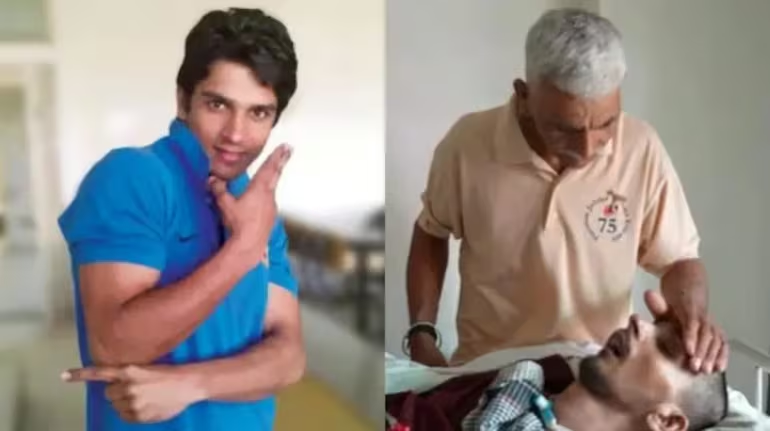
Harish Rana was a 31-year-old BTech student from Ghaziabad, Uttar Pradesh, who became the centre of India’s most significant legal case on the right to die with dignity. On March 11, 2026, the Supreme Court of India permitted passive euthanasia in his case — the first time India’s courts had practically implemented the passive euthanasia guidelines established in 2018. On March 24, 2026, Harish Rana passed away at AIIMS, New Delhi at 4:10 PM, bringing to a close 13 years of suffering for a young man who never regained consciousness after a tragic accident in 2013. His family donated his corneas and heart valves after his death.
Harish Rana Biography
| Full Name | Harish Rana |
|---|---|
| Date of Birth | August 10, 1994 |
| Age at Death | 31 years |
| Hometown | Rajnagar Extension, Ghaziabad, Uttar Pradesh |
| Father | Ashok Rana |
| Education | BTech, Panjab University, Chandigarh (incomplete) |
| Accident Date | August 20, 2013 (Raksha Bandhan) |
| Condition | Permanent Vegetative State (13 years) |
| SC Verdict | March 11, 2026 — passive euthanasia permitted |
| Date of Passing | March 24, 2026, 4:10 PM, AIIMS New Delhi |
| Organ Donation | Corneas and heart valves donated |
Early Life — Before the Accident
Harish Rana grew up in Rajnagar Extension, Ghaziabad, in a middle-class family. His father, Ashok Rana, worked to give his children a stable upbringing. By all accounts, Harish was a focused and studious young man — he secured admission to Panjab University in Chandigarh to pursue a BTech degree in Civil Engineering, a significant achievement for a family from Ghaziabad.
Like many students from UP and Delhi-NCR, he moved to Chandigarh for his studies and lived in a paying guest accommodation near the university. He had plans for internships, a career in engineering, and a future that seemed well within reach. He was 18 years old when the accident happened.
The Accident — Raksha Bandhan, August 20, 2013
On Raksha Bandhan, August 20, 2013, Harish Rana fell from the fourth-floor balcony of his paying guest accommodation in Chandigarh. The fall caused severe traumatic brain injury. He was rushed to hospital and survived — but the damage to his brain was irreversible.
Doctors concluded he was in a Permanent Vegetative State (PVS). This means he showed sleep-wake cycles — his eyes would open and close — but there was no meaningful interaction with his surroundings, no ability to speak, move voluntarily, or respond to people around him. He could not eat on his own and was kept alive through a PEG tube delivering clinically assisted nutrition and hydration (CANH). He required round-the-clock nursing, physiotherapy, and medical supervision.
He was 18 years old at the time of the accident. He never regained consciousness.
13 Years of Waiting — The Family’s Struggle
What followed was over a decade of extraordinary devotion by Harish’s family, and extraordinary suffering.
His parents brought him home from hospital and provided daily care themselves — feeding through tubes, keeping him clean, managing his medication, coordinating physiotherapy. Neighbours in Rajnagar Extension watched the family’s routine for years. The financial toll was immense. The family spent their savings on repeated hospitalisations, medical equipment, nursing support, and treatment. At one point, they sold their home in Mahavir Enclave, Delhi, and moved to Ghaziabad to manage the costs of his care.
For 13 years, there was no recovery. No flicker of consciousness. No change in his neurological state. Medical boards that assessed him over the years consistently concluded that the possibility of recovery was negligible and that his neurological damage was irreversible.
The Supreme Court, when it finally heard the case, described the family’s journey in its judgment: “To love someone is to care for them not just in times of joy, but in their saddest and darkest hours.” The bench said it had been “gripped by profound sadness” throughout the proceedings.
The Legal Battle — From Delhi High Court to the Supreme Court
In July 2024, Harish’s father Ashok Rana approached the Delhi High Court seeking permission for passive euthanasia — the withdrawal of life-sustaining treatment to allow his son to die naturally. The Delhi High Court rejected the petition in 2024, holding that Harish did not qualify because he was not “terminally ill” in the conventional sense and was not on a mechanical ventilator.
The family appealed to the Supreme Court of India.
On March 11, 2026, a bench of Justices JB Pardiwala and KV Viswanathan delivered a landmark judgment. The court:
- Permitted the withdrawal of Clinically Assisted Nutrition and Hydration (CANH) — the PEG tube feeding keeping Harish alive
- Overruled the Delhi High Court’s interpretation, clarifying that a patient in a Permanent Vegetative State qualifies for passive euthanasia regardless of whether they are on a mechanical ventilator
- Directed AIIMS Delhi to admit Harish to its palliative care unit and supervise the withdrawal in a structured, dignified manner
- Waived the mandatory 30-day reconsideration period given the circumstances
- Urged Parliament to enact comprehensive legislation governing end-of-life decisions in India
The court addressed Harish’s family directly in its judgment: “This decision can feel like an act of surrender, but we believe it is, in truth, an act of profound compassion and courage. You are not giving up on your son. You are allowing him to leave with dignity.”
What is Passive Euthanasia? — Simply Explained
This case brought passive euthanasia into national conversation. Here is what it means:
Passive euthanasia involves withdrawing or withholding life-sustaining medical treatment — such as a ventilator, feeding tubes, or hydration — and allowing the patient to die naturally. It does not involve administering any drug or injection to cause death.
Active euthanasia — where a substance is administered to cause death — remains illegal in India.
Passive euthanasia was first recognised by the Supreme Court in the Aruna Shanbaug case (2011) and was formally legalised under strict conditions in the Common Cause v. Union of India judgment (2018), which also recognised the right to die with dignity as part of the fundamental right to life under Article 21 of the Constitution.
The Harish Rana case is the first practical implementation of the 2018 guidelines for an individual case — making it a landmark moment in Indian legal history.
The Final Days — AIIMS and Passing
After the Supreme Court’s March 11 verdict, Harish’s family shifted him from their Ghaziabad home to AIIMS, New Delhi. In an emotionally charged moment that many found deeply symbolic, the family chose to transport him in their private vehicle rather than an ambulance.
He was admitted to the Palliative Oncology Unit (IRCH) at AIIMS, under the care of Dr. (Prof.) Seema Mishra, Head of Department, Onco-Anaesthesia. The medical team gradually withdrew his artificial nutritional support under strict supervision, while ensuring his comfort and pain management.
A 22-second video that circulated online showed Harish’s mother sitting beside him in his final days, visibly devastated, while a member of the Brahma Kumaris applied a tilak on his forehead and spoke gently to him.
Harish Rana passed away at 4:10 PM on March 24, 2026.
AIIMS issued a press release confirming his death and extending condolences to the family. His family donated his corneas and heart valves — a final act of generosity that his father Ashok Rana had been quietly planning for over two years before the court verdict, having approached the Dadhichi Dehdaan Samiti, an organ donation awareness organisation, as early as 2023.
Why This Case Matters for India
The Harish Rana case has implications that extend far beyond one family’s grief.
It is the first time India’s passive euthanasia framework — established in theory in 2018 — was actually applied to a real patient by court order. The Supreme Court used the judgment to issue broader directives: High Courts across India have been asked to instruct Judicial Magistrates to receive intimations whenever Medical Boards decide to withdraw life support; Chief Medical Officers in every district have been directed to maintain panels of doctors qualified to serve on Secondary Medical Boards.
The court also made a direct appeal to Parliament to enact a comprehensive End-of-Life Care Act — covering living wills, surrogate decision-making by families, and palliative care protocols — describing its own judgment as a “temporary constitutional bridge” until such legislation exists.
Also Read
- Ajit Doval Biography — India’s National Security Advisor and Spymaster
- APJ Abdul Kalam Biography — The Missile Man of India
- Sudha Murthy Biography — Infosys Foundation Chairperson and Author
- Rabindranath Tagore Biography — Nobel Laureate and Bengali Polymath
Frequently Asked Questions (FAQ)
Q: Who is Harish Rana?
A: Harish Rana was a 31-year-old BTech student from Ghaziabad, Uttar Pradesh, who fell from the fourth floor of his paying guest accommodation in Chandigarh on August 20, 2013, and spent 13 years in a Permanent Vegetative State. He became the subject of India’s first court-approved passive euthanasia case and passed away on March 24, 2026, at AIIMS, New Delhi.
Q: What happened to Harish Rana?
A: On Raksha Bandhan, August 20, 2013, Harish fell from the fourth-floor balcony of his PG accommodation in Chandigarh while studying engineering at Panjab University. The fall caused severe traumatic brain injury that left him in a Permanent Vegetative State. He never regained consciousness.
Q: What is passive euthanasia and why is Harish Rana’s case historic?
A: Passive euthanasia means withdrawing life-sustaining treatment — such as feeding tubes or ventilators — and allowing a patient to die naturally, without administering any drug to cause death. While the Supreme Court had legalised passive euthanasia in principle in 2018, Harish Rana’s case is the first time these guidelines were practically applied to an individual patient by court order, making it a landmark in Indian legal history.
Q: What did the Supreme Court decide in the Harish Rana case?
A: On March 11, 2026, a Supreme Court bench of Justices JB Pardiwala and KV Viswanathan permitted the withdrawal of clinically assisted nutrition and hydration (CANH) for Harish Rana, directed AIIMS to provide palliative care, and urged Parliament to pass comprehensive end-of-life legislation.
Q: When did Harish Rana die?
A: Harish Rana passed away at 4:10 PM on March 24, 2026, at AIIMS, New Delhi, under the care of the Palliative Oncology Unit led by Dr. Seema Mishra.
Q: Did Harish Rana’s family donate his organs?
A: Yes. Following his death, the family donated his corneas and heart valves — a decision his father Ashok Rana had been planning for over two years, reflecting the family’s desire to find meaning in their son’s long and painful journey.
Q: Who is Harish Rana’s father?
A: Harish Rana’s father is Ashok Rana, who led the legal battle to allow his son to die with dignity. The family lived in Rajnagar Extension, Ghaziabad, and sold their Delhi home to fund over a decade of medical care for Harish.